
Executive Summary
For council, boards and managers in British Columbia and Alberta, the practical difference between an update and a renewal is mostly about scope, baseline quality, and legal sufficiency. In both provinces, the law requires a professionally prepared, current long-range capital planning document on a five-year cycle. In both BC and Alberta, the statutes and regulations speak in terms of obtaining a renewed depreciation report every five years. Although these are sometimes referred to as “update” in legislation, it really is a comprehensive renewal. An update is typically a soft refresh of the cost estimations and of the point-in-time position of the reserve.
That means a legally compliant “update” in either province is not just a tables’ refresh. In BC, a renewed depreciation report still requires another visual on-site inspection and revised timing, costs, reserve balances, and funding models. In Alberta, the five-year review is subject to section 23, which requires an on-site visual inspection of visible depreciating property.
The common Class 1 / Class 2 / Class 3 vocabulary used across Canada is still helpful. It distinguishes between a comprehensive study, an update with a site visit, and an update without a site visit. But those labels come most clearly from Ontario’s class system and are not formal statutory categories in Alberta or BC. For BC and Alberta councils/boards, the real question is simpler: does the scope still satisfy your provincial law, and is it accurate enough to govern real money decisions?
Reserve Fund vs Study
A reserve fund is the money set aside for major repair and replacement. In BC, the equivalent fund is the contingency reserve fund, which exists for common expenses that occur less often than once a year or do not usually occur. In Alberta, the Act requires a reserve fund reasonably sufficient for major repairs and replacement of the corporation’s real and personal property, common property, and managed property.
The study/report is the planning document that tells the board what the property owns, how fast major components are wearing out, what future work may cost, and how the fund may be guided. BC calls that document a depreciation report. Alberta separates the process into a reserve fund study, a reserve fund report, and a board-approved reserve fund plan. Alberta’s regulation also requires the study provider to inspect visible depreciating property, interview the board, review key documents, and recommend the funding needed to maintain adequacy.
This distinction matters. The fund is the cash. The study is the evidence-based roadmap for deciding how much cash should be there, when, and why. Confusing the two is one of the main reasons boards assume a low-cost “update” is enough when the property actually needs a fresh baseline.
What the Law Says in British Columbia
BC now requires virtually all strata corporations with five or more strata lots to obtain depreciation reports on a five-year cycle. BC’s key point for this article is that the statute requires a strata corporation to obtain a depreciation report by the dates set in the regulation, and the regulation requires the physical component inventory to be based on an on-site visual inspection conducted by the person preparing the report. BC’s own guidance also says that “getting another depreciation report does not mean starting from the very beginning,” but an updated report still means another visual inspection, revised timing, revised costs, updated reserve balances, and refreshed cash-flow models.
So, in BC, the usual industry distinction between “update” and “renewal” is mostly a scope and workflow distinction, not a legal one. A lighter, no-site financial refresh may help a board think through an interim budget issue, but it is not a legal substitute for the five-year depreciation report because BC requires the report itself to include an on-site visual inspection.
What the Law Says in Alberta
Alberta’s Condominium Property Act requires condominium corporations to establish and maintain a reserve fund. The Regulation requires the corporation to complete the initial reserve fund study, report, and plan within two years after registration of the condominium plan. It then requires a five-year review measured from the date the most recent reserve fund plan was approved.
Alberta’s five-year review is the critical legal provision. Section 30 says that, on or before five years from the approval of the most recent plan, the corporation must, in accordance with the same procedures, requirements and restrictions to which section 23 is subject, carry out a reserve fund study, prepare a reserve fund report, approve the plan, and provide the approved plan to owners before collecting funds for the work addressed in that report. Because section 23 includes an on-site visual inspection of visible depreciating property, Alberta’s statutory five-year update is also not a records-only update.
Alberta does have a few notable nuances. For plans with not more than 12 units, the corporation may perform the functions of a reserve fund study provider if authorized by special resolution. There is also a rental-only exemption in certain narrow circumstances. But for most condominium corporations, the practical rule is straightforward: the five-year deliverable is a fresh legal study/report/plan process with inspection, not just a financial reforecast.
Update Types and When Each One Makes Sense
Across Canadian reserve planning practice, boards often use a three-part vocabulary: comprehensive study, update with site visit, and update without site visit. Ontario’s Condominium Authority of Ontario describes those classes explicitly, and that framework is useful when BC and Alberta boards are comparing scope options. The caution is that Alberta and BC do not adopt those class labels in their statutes, and both provinces require inspection for the legally required cycle.
| Type | Typical scope | BC equivalent / AB status | Est. market cost* | Pros | Cons | Appropriate when |
|---|---|---|---|---|---|---|
| Comprehensive study / renewal | Rebuilds or thoroughly revalidates the component inventory, condition opinions, costs, reserve balance, and funding models | BC: new depreciation report; AB: fully compliant study/report/plan | ~C$3,000–15,000+ | Strongest baseline, best for poor legacy data, easiest to defend | Highest cost and effort | First study, major provider transition, major property change, weak or outdated prior study |
| Update with site visit | Uses the prior study as a starting point, but verifies condition on-site and revises lives, costs, completed work, and cash flow | BC: usually the practical form of a five-year “updated” report; AB: can satisfy the five-year review if full statutory content is still met | ~C$2,000–10,000+ | Lower cost than a full rebuild; still grounded in observed condition | Savings disappear if prior study is poor or undocumented | Prior study is recent and reliable; board needs a compliant refresh rather than a reset |
| Update without site visit | Records-based financial refresh using prior inventory, actual fund balance, and recent project history | BC: not a legal depreciation report; AB: not sufficient for the statutory five-year review | ~C$1,000–5,000 | Cheapest and fastest interim planning tool | Highest risk of missing condition changes; not a legal substitute in BC/AB | Interim budgeting between legal cycles, or post-project financial refresh only |
*Illustrative western-Canada market estimates only. Fees are not standardized and vary materially with building size, complexity, amenities, documentation quality, and whether historic data can be reused. BC guidance expressly notes that pricing depends on size and complexity and that using the same provider may offer cost savings; recent provider guides in BC and Alberta show full-study pricing ranging from low-thousands for small properties to much higher for large or complex sites.
Decision checklist for boards
Use the checklist below as a practical screen. It is analytical, not statutory. The law still controls.
| Indicator | Lean toward update with site visit | Lean toward full renewal |
|---|---|---|
| Quality of prior study | Clear inventory, transparent assumptions, editable files | Generic template, missing assumptions, outdated component list |
| Physical change since last study | Mostly normal aging; few completed major projects | Major repairs, failures, claims, asset additions/deletions, changed maintenance responsibility |
| Funding volatility | Need to refresh interest, inflation, and actual reserve balance | Existing study no longer supports realistic funding strategy or reserve adequacy |
| Provider continuity | Same provider, or smooth transfer with strong digital records | New provider with weak handover; rebuilding inventory is likely |
| Risk tolerance | Board needs a compliant refresh at lower cost | Board wants a new baseline it can rely on for major decisions, borrowing, or large levies |
The most important decision criterion is not price. It is whether a lighter scope would create false savings by leaving the board with a report that is either non-compliant or too weak to support capital planning. BC’s guidance specifically asks boards to consider inspection scope, post-presentation services, electronic access to update materials, and the possibility that the same provider may produce cost-effective updates.
Timing, Provider Transitions, and the Risk of Outdated Studies
The legal cadence is five years in both provinces, but boards should not treat five years as a sacred waiting period. BC says reports need updating because assets may last longer or shorter than expected, replacement costs change, inflation and investment returns change, and items may need to be added to or deleted from the inventory. Alberta public legal guidance similarly notes that corporations may prepare reserve fund studies and plans more often than every five years.
A board should seriously consider an earlier refresh after a major envelope or parkade project, a significant claim or failure, a change in maintenance obligations, a sudden cost inflation event, or a strategic shift in funding philosophy. Those are exactly the situations where a no-site update can be tempting but dangerous; the financial model may change, but the physical assumptions may be wrong. That is why inspection-based updates remain the safer default for legal-cycle work in BC and Alberta.
Provider transition is often where “update” quietly becomes “renewal.” There is generally no legal rule requiring a board to stay with the original provider. The practical message is clear: another provider can usually take over, but the incoming consultant will need to rebuild the baseline from scratch.
Outdated studies create real risk. BC says the report helps owners avoid surprise special levies and provides valuable information to prospective buyers, lenders, and insurers; the most recent depreciation report also has to accompany the Form B Information Certificate. Alberta guidance warns that inadequate reserve planning can lead to contribution shocks, special levies, reduced market appeal, and difficulty selling. For boards, the governance risk is equally important: a stale study makes every funding decision harder to justify.
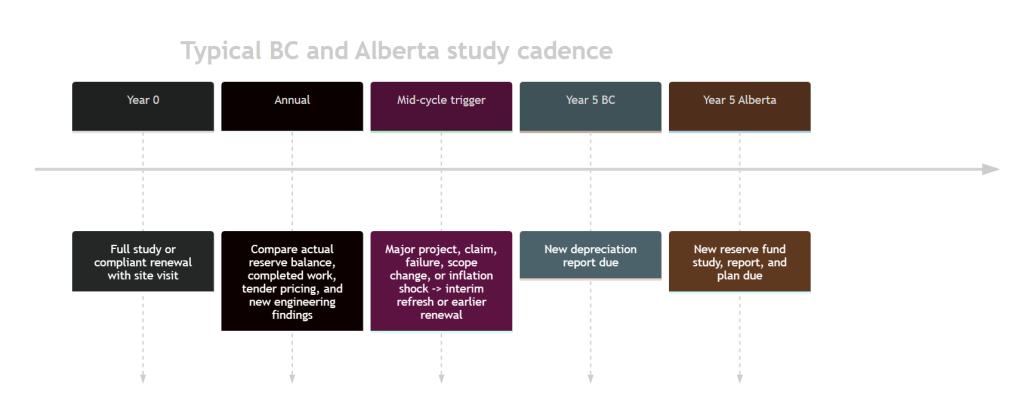
The useful practical distinction is this: use the lightest scope that is still compliant and decision-useful. If a cheaper update will not survive due diligence, procurement, or owner scrutiny, it is not actually cheaper.
Frequently Asked Questions
Who can prepare a study?
In BC, as of July 1, 2025, only six designated professional groups may prepare depreciation reports, including engineers, architects, certain technologists/technicians, AACI appraisers, Certified Reserve Planners, and Professional Quantity Surveyors. In Alberta, the Regulation sets out qualified reserve fund study providers and disqualifications; for very small plans of not more than 12 units, the corporation may act as provider if authorized by special resolution.
Can one provider update another provider’s study?
Usually no. The issue is often professional standards that do not allow for reliance on other consultants’ work for the study baseline. Another issue is data portability and scope efficiency. Most often, the incoming provider has to reconstruct the inventory and assumptions, which pushes the assignment closer to a renewal.
Is an update cheaper than a renewal?
Usually yes. Same provider will typically offer cost savings.
Can updates be done without a site visit?
They can be done as an interim planning exercise, but not as the statutory five-year substitute in BC or Alberta. BC requires the depreciation report to be based on an on-site visual inspection. Alberta’s section 30 imports section 23’s procedures into the five-year review, and section 23 requires an on-site visual inspection of visible depreciating property.